Friday, October 5, 2018

2D Character & Environment Project


Initial Concept :

Story - Little Red Riding Hood

World - Modern Zombie Apocalypse

"The road to grandma's house has never been so dangerous..."

Game Style Inspiration: RWBY


Thursday, October 4, 2018

2D 3-Point Lighting

Taking a crack at 3 point lighting this week.

Posed reference object


Trying a new painterly style wherein I take the base line art of the image, then overlay it with my original so I can pick and block out layered color combinations found throughout the image, and use the smudge tool to blend and add a bit of stabilization to the image.


Monday, October 1, 2018

3D Cannon UVs and High Poly Details

This week we add additional high poly details and map more standardized UVs to our previous cannon asset.

We start with the game poly model we ended with last week.


Using a mixture of planar and cylindrical mappings, we start to layout and scale our UV faces.


After breaking the model down in a manner that allows our seams to hide on the underside of the model, and make cohesive sense UV work space, I scaled the pieces to form a consistent pixel resolution throughout the model.


After our UVs were created, we worked on our soft poly mesh model, and added geometry on our corners to allow the cannon to maintain its core shape.


Once satisfied with the high poly mesh, I converted the soft poly model to actual geometry and exported the cannon out as a .obj file.

Opening my export in Zbrush, I began working on adding finer details to the mesh.


I wanted my cannon to look like it had been through countless battles and had earned every crack and scar across its surface. I scuffed the edges, rusted down metal, and added large cracks running throughout the model.

Once my additional details were completed, I decimated the model down to roughly 2 million polygons in Zbrush and ended with a visible map of the additional geometry.


Thursday, September 27, 2018

2D Week 5 Perspective - John Berkey

This week we are working on the use of 1, 2, and 3 point perspective in 2D art. For our reference artist, we look to the work of John Berkey and his futuristic renditions.

For my piece, I wanted to recreate this work from the Chronicles of the Lensman, book cover.


While this image has a slight fish-eye lens style skew to it, I was able to identify a rough 3 point perspective that constructs the overall shape.


To assist with recreating this work we used 3D modeling tools in maya to roughly construct the image in a digital space.


With the 3D model rendered out, I could use my original image, and my 3D model to sketch out the shape of my image.


All that's left to do is to add some values to the ship and background to get my final image.


Sunday, September 23, 2018

3D Modeling a Cannon

This week we will be modeling a simple prop, a cannon for an alien pirate ship. We will specifically be focusing on creating the proxy version of our prop.

We first set up our scale. Using the model exported from UE4 we scale our reference imagery to the height we want when seen in game.


Using the reference imagery for size an shape, I went about creating a proxy object under 1000 polygons.


Once the model was combined and mended together, I generated a set of automatic UVs for this proxy. We will go into greater detail on the UVs in a later week, but the auto function will work for our testing.


With everything now ready for export, I created an FBX of our cannon and pulled it into UE4 for scale comparison and making sure our faces render properly.


From here, we can render out final details and render out our wire frame.

Using the boolean functions, I can cut additional shapes out of my cannon model.


With the final edits to our cannon placed, and our polygons reduced, we can use the render tool to produce a clean view of our cannon in wire frame mode.


Thursday, September 20, 2018

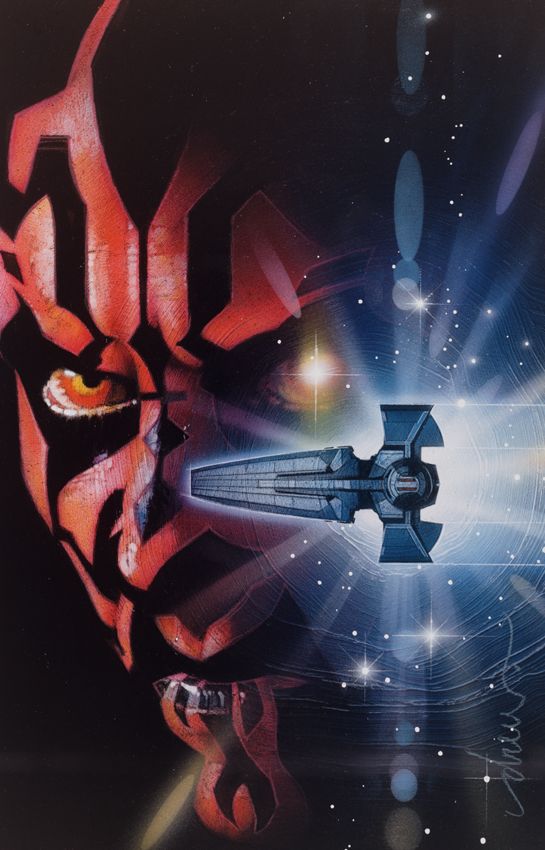
2D Compositions - Drew Struzan

This week we are focusing on the art of visual compositions. The structure of an image that allows a natural direction for the viewer eye to a target area, or make them feel like they are actually in your image. Drew Struzan utilized composition like a science during his career making movie posters. For this assignment, I will be taking one of his posters and recreating the image, ensuring the key elements of composition are carried over in the end product.

For this assignment I will be using his poster "Star Wars Darth Maul #2" that was used as the final key cover art for the marvel paperback comic.


In this image, I can identify at least 3 different compositional structures that are used by Drew to direct the viewers eye:

Radial


Cross


Circular


Using these structures, Drew can direct how a viewer's gaze tracks across his work, and with that, ensure the elements of his work that he deems most important are viewed first.

To start, I began with the basic background and Darth Mauls Facial patterns.


With my base down, I added some of the compositional elements down; with the ship and reflective light adding the cross/radial scenes to the work.


I then went in and cleaned up the two subjects of my image and added some comic-style shading to add an element of depth.


To add the final circular composition, and polish up the rest of the image, I added additional back lighting, bloom, and circular strobe patterns to the ship.


Monday, September 17, 2018

3D Lego Project - Week 2

With the original block completed and ready for LOD iterations, I worked with my team to arrange the remainder of our required unique Lego models.

For the ballista we were creating, I set off to create a few more high poly meshes:

Stepped Arch


157° Hinge


2x2 Corner


10x1 Ported Beam


Wagon Wheel


With these pieces I could create a blueprint of the ballista wagon and send it off to my team lead. Using this structure, we can quickly import multiple siege weapons into our scene.


Here is the finished product!